
Wondering about Sydney scalp micropigmentation longevity? Learn how scalp type, sun exposure, treatment depth and aftercare can affect SMP results, with realistic 3-year follow-up considerations.
Sydney SMP Longevity: How Long Does SMP Really Last?

Sydney scalp micropigmentation longevity is commonly discussed in terms of how many years the pigment remains visible, but the more useful question is how naturally the treatment fades over time. Factors such as scalp type, UV exposure, pigment placement, lifestyle and aftercare can make a noticeable difference.
For someone considering SMP in Sydney, there is also a local factor worth considering: Australia has high levels of UV exposure, and people who spend significant time outdoors may notice fading differently from someone who spends most of their time indoors.
Rather than assuming that every SMP treatment lasts exactly the same amount of time, it is more realistic to look at what can happen around the 2- to 4-year mark and what determines whether a refresh is actually needed.
Why Does Sydney Scalp Micropigmentation Fade Differently From Person to Person?

Scalp micropigmentation is designed to create the appearance of hair follicles using small pigment impressions in the scalp. It is not the same as a conventional body tattoo, and the intended result is a natural-looking change in density rather than permanent, deep pigment saturation.
The longevity of SMP can vary considerably depending on several factors.
1. Scalp Type and Oil Production
People with an oily scalp may experience faster visual fading than those with a relatively dry scalp.
Frequent washing, sweating and increased sebum production can influence how the scalp looks as the pigment gradually becomes lighter.
This does not mean that oily skin automatically causes an SMP treatment to fail. It simply means that the timing of a refresh may differ from person to person.
2. Sydney Sun Exposure
UV exposure is particularly relevant when discussing Sydney scalp micropigmentation longevity.
Regular outdoor activities such as beach visits, running, hiking, cycling or working outdoors can increase cumulative sun exposure.
Over time, UV exposure can contribute to pigment fading and changes in the overall appearance of the scalp.
For this reason, sun protection should be considered part of long-term SMP maintenance rather than something that only matters immediately after treatment.
3. Pigment Placement and Technique
The depth and consistency of pigment placement are important.
The goal is not simply to make the pigment last as long as possible. Placing pigment excessively deep in the skin can create an unwanted appearance as the pigment ages or spreads.
A good SMP result should gradually become softer and less noticeable rather than remaining artificially dark for many years.
3 Realistic Differences You May Notice Around Year Three
A three-year follow-up does not necessarily mean that every client needs another treatment.
In practice, there are several different patterns that may appear.
Difference 1: The Colour Becomes Softer
One of the most common changes is gradual loss of intensity.
The original treatment may have looked relatively crisp and defined, while several years later the same area can appear softer and less contrastive.
This can actually be a positive sign if the individual follicle impressions remain visually controlled.
A light refresh may be enough if the underlying shape and density are still appropriate.
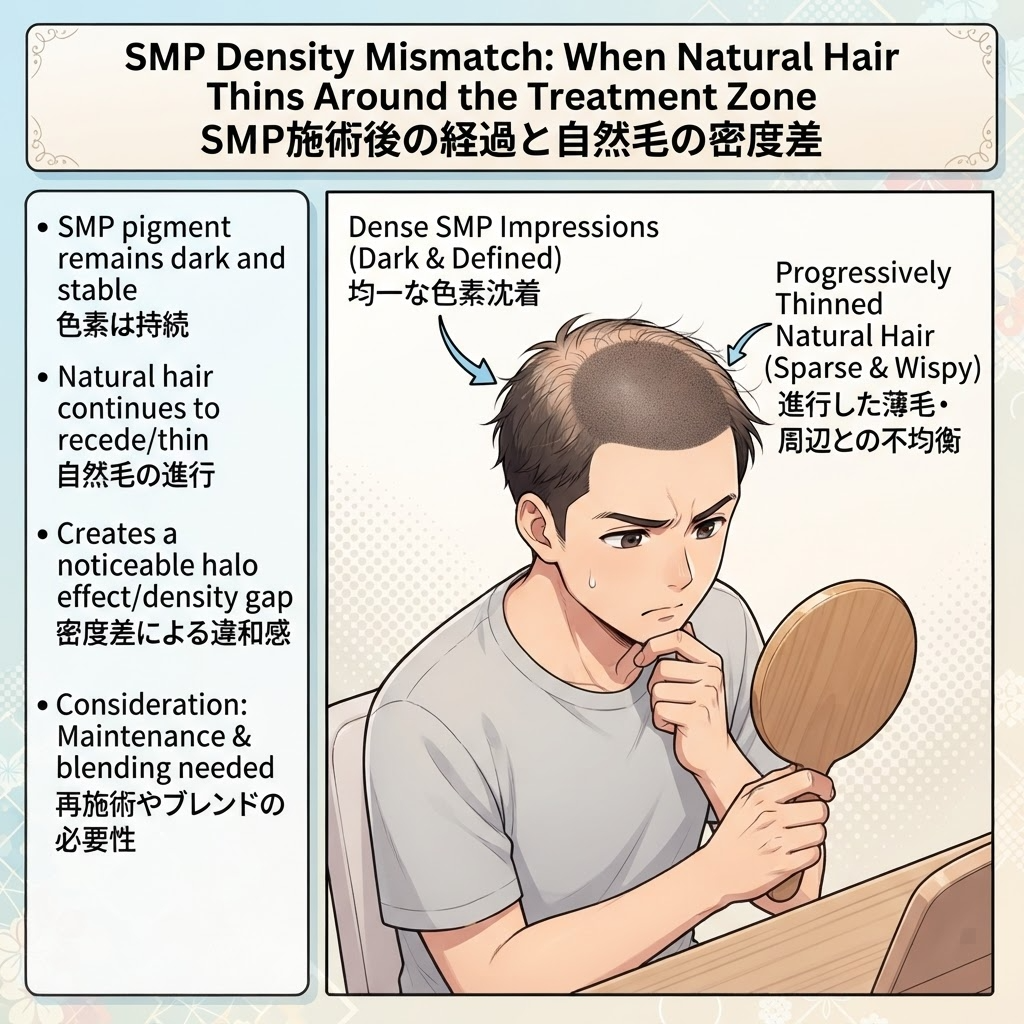
Difference 2: Density Can Appear Different as Hair Loss Progresses
SMP does not stop hair loss.
If natural hair continues to thin after treatment, the original pigment pattern may no longer provide the same visual density.
For example, someone who initially treated mild crown thinning may later experience additional thinning around the crown.
In this situation, the issue is not necessarily that the SMP pigment has disappeared. The surrounding natural hair has changed.
This is one reason why a three-year review should assess both the pigment and the current hair-loss pattern.
Difference 3: Poorly Placed Pigment Can Become More Noticeable
The most important long-term concern is not always fading.
If pigment has been placed too deeply, excessively densely or inappropriately for the person’s natural hair pattern, ageing can make the result look less natural.
Instead of neat follicle-like impressions, the area may appear overly saturated or less defined.
This is why asking for the darkest possible and longest-lasting SMP is not necessarily the best approach.
Long-term quality matters more than simply maximising pigment retention.
What Should You Check Before Choosing SMP in Sydney?
If you are comparing SMP providers in Sydney, don’t focus only on photographs taken immediately after treatment.
Ask to see healed and longer-term results whenever possible.
Before Treatment, Check These Points
1. Healed results
Freshly completed SMP can look darker than the final healed result. Ask how the work looks after healing.
2. Long-term examples
If possible, look for examples taken months or years after the original treatment.
3. Your current hair-loss pattern
Consider whether your hair loss is stable or continuing.
A treatment plan that works for a stable hairline may need to be approached differently when thinning is actively progressing.
4. Your lifestyle
Regular swimming, outdoor work, sports and frequent sun exposure should be discussed before treatment.
5. Colour and density
The pigment should be selected according to your natural hair colour, skin tone and existing follicle pattern rather than simply choosing the darkest available shade.
Does SMP Need a Touch-Up After 2 or 3 Years?
Not necessarily.
There is no universal date at which every person needs a touch-up.
Some people may still be happy with their result after several years, while others may prefer a refresh earlier because the contrast has reduced.
A better approach is to assess the treatment based on its current appearance.
A refresh may be worth considering when:
- the overall density looks noticeably lighter
- the hairline no longer matches the natural hair pattern
- continued hair loss has changed the treated area
- UV exposure has contributed to significant fading
- the client wants to restore some of the original contrast
The key is to avoid automatically adding more pigment simply because a certain number of years have passed.
How Can You Help Maintain Sydney SMP Results?
Long-term maintenance is relatively straightforward, but consistency matters.
Protect Your Scalp From Excessive UV Exposure
Sydney’s outdoor lifestyle makes sun protection particularly important.
A suitable scalp sunscreen or physical protection such as a hat can help reduce cumulative UV exposure.
Follow Initial Aftercare Instructions
Immediately after SMP, follow the specific aftercare instructions provided by your practitioner.
Avoid introducing additional products or activities that have not been recommended for the treated area during the early healing period.
Avoid Trying to Make the Treatment Permanently Dark
A common misconception is that a deeper treatment automatically means a better or longer-lasting treatment.
That is not necessarily the case.
The objective should be a controlled, natural-looking result that ages well.
Sydney SMP: What Should You Expect After Three Years?

There is no single “three-year result” that applies to everyone.
A realistic three-year outcome can range from a subtle reduction in pigment intensity to a more obvious need for density adjustment, particularly when natural hair loss has continued.
The important distinction is how the treatment fades.
A well-planned result should generally become progressively softer rather than suddenly looking unnatural.
For anyone researching Sydney scalp micropigmentation longevity, this is often more useful than focusing on a fixed number of years.
Frequently Asked Questions
How long does Sydney scalp micropigmentation last?
The visible effect can vary significantly between individuals. A commonly discussed timeframe is around 2–4 years before some people consider a refresh, but this is not a guaranteed lifespan.
Scalp type, UV exposure, lifestyle, pigment characteristics, treatment technique and ongoing hair loss can all influence the result.
Does SMP completely disappear after several years?
Not necessarily.
SMP generally fades gradually rather than disappearing suddenly. The amount of remaining pigment depends on the original treatment and individual skin characteristics.
Can I have SMP if my hair loss is still progressing?
It may be possible, but the treatment plan should take future hair loss into account.
If the treated area remains fixed while surrounding hair continues to thin, the overall balance can change over time.
Is longer-lasting SMP always better?
No.
For scalp micropigmentation, natural ageing of the pigment is an important consideration. Excessively deep or overly saturated pigment may create more problems later if it does not fade in a controlled way.
Does Sydney’s sun affect SMP longevity?
Regular UV exposure can contribute to fading over time. People who spend considerable time outdoors should discuss sun protection and long-term maintenance with their SMP practitioner.
The Most Important Point About SMP Longevity
When considering Sydney scalp micropigmentation, don’t judge the quality of a treatment only by how dark it looks immediately after the procedure.
The better question is:
“How will this look after one year, three years and as my natural hair changes?”
A good long-term plan considers your current hair loss, scalp characteristics, lifestyle, sun exposure and the way pigment is expected to age.
The goal is not simply to make SMP last as long as possible.
The goal is to create a result that continues to look natural as time passes.


